
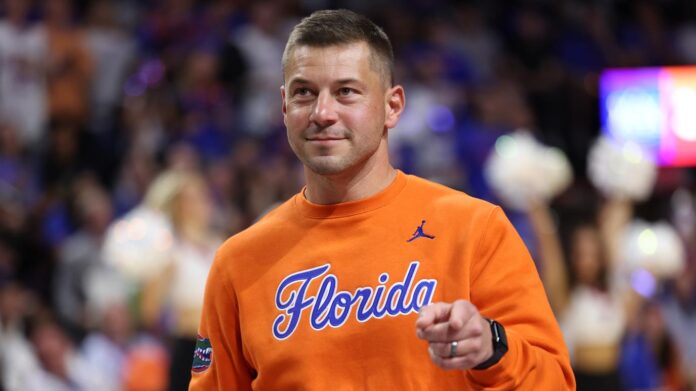
GAINESVILLE, Fla. — Former Florida coach Urban Meyer believes the program’s latest reset under Jon Sumrall could restore competitive momentum, offering a public endorsement of the new coach while pointing to culture and standards as key indicators of progress.
Speaking on his podcast “The Triple Option”, Meyer urged observers to pay attention to the program’s direction.
“You watch out for Florida man,” Meyer said. “I’m buying that stock right now. I’m buying it. That Swamp is gonna be like a jet engine, like it used to be.”
The comments arrive months after Florida hired Sumrall to lead the program following four seasons under Billy Napier, a stretch that included a losing overall record and inconsistent on-field results.
Sumrall entered the role with a résumé that includes a combined record at 43-12 across stops at Troy and Tulane, including a postseason appearance at the national level during his final year with the Green Wave.
Florida administrators turned to him amid broader program instability after a 4-8 campaign, with the hire formalized on a multi-year contract reported to be valued at roughly $6.5 million annually plus incentives.
Culture and Expectations
Meyer, who coached Florida from 2005 to 2010 and won two national championships, has followed the transition closely and attended Sumrall’s introductory news conference.
His endorsement extends beyond general optimism and reflects approval of the structural methods Sumrall has introduced within the program.
One notable example involves requiring players to earn the right to wear the school’s logo on practice gear, a tactic Meyer previously used.
“I love it,” Meyer said. “I agree with it.”
Sumrall explained the philosophy bluntly in January.
“We haven’t earned a damn thing,” he said. “All we’ve got is our name. When are we gonna put our freaking name on everything? To wear the Florida Gator logo, to wear the Gators across your helmet and script and Gator head man, you’ve go to earn that.”
The approach echoes Meyer’s own methods when he arrived in Gainesville, when similar internal policies were implemented to reinforce performance expectations and program identity.
“I did it at a couple of stops,” Meyer said. “Bowling Green I did it, but we didn’t have gear. We didn’t have enough money to buy gear. Utah we did it to a degree. I’m just a firm believer that you have to earn it. Once you earn it, you really get rewarded. That’s the way I was brought up, and that’s what I believe in.
“At Florida, we took everything away and I wanted to prove a point. The expectations are a National Championship caliber team and that’s what Steve Spurrier did. If you’re not doing that, you’re going to hear it. I expect that out of this staff and out of the players. They weren’t allowed to wear Florida gear, and you earned it back.
“There was a time where coaches would get a raise as a staff. I took that away. I said ‘we’re not doing that’. If you’re a great coach you get a bigger raise. If you’re not a great coach, you won’t get the raise. We don’t do it as a group. You do it as individuals. Same with the team. You don’t just earn it back, you earn it back if you bust your ass.”
Meyer’s tenure in Gainesville produced a 65-15 record and two national titles, part of a broader college career that included three championships and a .853 winning percentage.
Coaching Alignment and Mentorship
Sumrall’s connection with Meyer predates his hiring. The two spoke during the search process, discussing offseason preparation and conditioning structure.
Meyer told Sumrall he felt the conversations resembled speaking with a younger version of himself, a comment Sumrall described as a meaningful compliment.
Sumrall credited Meyer’s openness to offering guidance while he acclimates to the role, noting the importance of drawing from previous program builders while establishing his own approach.
That approach centers on competitiveness and physical play. Sumrall said at his introductory remarks that the program’s expectation remains championship contention and emphasized effort and discipline as foundational elements.
The transition also follows measurable success at previous stops. At Troy, Sumrall produced consecutive conference titles, and at Tulane he compiled a winning conference record and a College Football Playoff appearance before departing for Florida.
Measuring Progress Ahead
Florida has not reached 10 victories in a season since 2019, which shows the competitive gap Sumrall faces entering the Southeastern Conference landscape.
Recent seasons illustrate the volatility of the program, from an SEC Championship Game appearance in 2020 to losing campaigns that prompted administrative change.
Meyer’s public backing reflects both familiarity with the job’s demands and recognition of the rebuild timeline required in modern college football, particularly amid transfer portal movement and evolving financial structures tied to roster management.
While results will ultimately determine the evaluation of Sumrall’s tenure, endorsement from a coach associated with the program’s most successful era adds context to expectations entering the next phase of competition.
The coming seasons will test whether structural changes and cultural emphasis translate into measurable improvement within conference play and postseason contention.

