
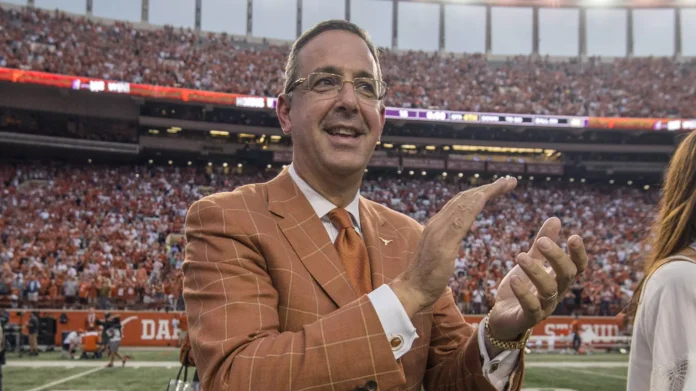
AUSTIN, Texas — Texas athletic director Chris Del Conte says college football’s calendar needs structural change, arguing the sport should begin its regular season earlier and replace conference championship games with the opening round of an expanded postseason.
In an extensive Town Hall type of interview, Del Conte outlined a vision that would shift kickoff to what is commonly known as “Week 0” and restructure the postseason calendar. His proposals are aimed at shortening a season that now extends deep into January.
The NCAA’s Week 0 typically features only a handful of matchups played one week before the broader opening weekend, traditionally staged before Labor Day.
Texas’ AD believes expanding that start window and reorganizing the postseason would better align academic calendars and player timelines while addressing the length of the modern College Football Playoff.
Ending Conference Title Games
Central to his proposal is eliminating conference championship games, which he views as redundant within a playoff-driven structure.
“I’m also in favor of why have a conference championship game,” Del Conte said. “Let’s start the playoffs that week, right? Start the playoffs that week, and let’s play every single week, and the semifinals are played on New Year’s Day, which is college football, and the national championship a week later.
“That’s what I’d like to see, but I’m one vote. But this is where we need to get to.”

He has argued that such a format would allow the postseason to conclude earlier and better match school schedules and transfer-portal timelines, both of which have become increasingly intertwined with competitive roster management.
The current playoff calendar continues to expand. The 2026 postseason schedule, for example, stretches from late December through late January, including semifinal windows pushed deeper into the month and a title game scheduled days later.
That lengthened timeline has fueled debate among administrators about competitive balance, player health, and scheduling overlap with the NFL postseason.
Expansion and Competitive Incentives
Del Conte’s broader argument also ties directly to playoff expansion. He has been outspoken about increasing participation beyond the current field, saying the system must evolve with the sport’s changing landscape.
“We’re trying to preserve an old system of bowl games,” Del Conte said. “We’re trying to preserve this whole idea of what college football was 30 years ago, 10 years ago, four years ago. Evolution is coming, and I firmly believe that the way we do the playoff is coming.
“We have to expand that playoff. We have to have more opportunities for teams. At the same time, we’ve got to honor strength in the regular season. “But if that does not happen, we are going to be forced into a position: don’t play anybody, let’s give it a go and see what happens at the end to get in the tournament.”
Texas narrowly missed the playoff last season by finishing just outside the selection line, an outcome that sharpened his position on access and scheduling equity.
Despite advocating structural change, Del Conte maintains support for strong regular-season matchups, including high-profile nonconference series emphasizing the importance of preserving fan engagement and television value.

“But before we joined the SEC, I made schedules of Ohio State and Michigan,” Del Conte said. “We had USC, we had LSU, because I was trying to make sure that your dollar that you’re spending with us, we’re bringing the best teams we could into DKR and play those great teams. That’s what we wanted. So we scheduled great games here to bring value to you all.
“At the same time, we were in the Big 12, and we’re looking at who we’re playing and who’s coming into DKR. And we lost A&M, we lost Nebraska, we lost those games. We weren’t playing at Missouri in the previous Big 12. So we looked at it differently. So we looked at value.”
Texas is scheduled to face multiple major-conference opponents in upcoming seasons and has indicated it intends to honor those commitments even amid conference scheduling shifts.
“I prefer to preserve the regular season by playing great games and not dumbing down your schedule and playing nobody with the hopes that you can get in the playoff because you played nobody,” Del Conte said. “If we can strengthen our regular season and keep that where our fans are engaged and want to see great games and have an expanded playoff, that’d be awesome.”
National Conversation Continues
Del Conte’s recommendations mirror broader administrative conversations about postseason structure, particularly as mega-conference membership and expanded television contracts reshape competitive priorities.
At least some administrators share concerns about the calendar’s length, with the most recent playoff season stretching from mid-December to mid-January and overlapping heavily with professional football coverage.
He has also expressed interest in starting playoff games earlier in December to create a cleaner competitive cadence, potentially replacing conference championship week entirely with postseason play.
“I’m also in favor of moving the schedule up a week,” Del Conte said. “Start Week Zero, which is the last week in August. Be a little hot here. We got to make sure it’s a night game. I get that. But start in the last week in August, and you play Labor Day weekend.”
While Del Conte emphasized he represents only one vote among decision-makers, his proposals display growing tension between tradition and modern revenue-driven realities.
As media rights value increases and roster management complexities deepen, the debate over calendar reform, from Week 0 expansion to championship week replacement, is likely to remain a central topic among conference commissioners and playoff stakeholders in the years ahead.

